

Project Name: India NEV Painting Line Project
Construction Company: SURICO
Location: India (Hot and Humid Climate)
Industry: New Energy Vehicles (NEVs)
Capacity: 20 JPH
Key Highlights: Modular Design · 3D Simulation · Remote Project Handover
Based on proven passenger vehicle painting processes, this project was specifically optimized for India’s hot and humid climate, as well as the enhanced protection requirements of NEV bodies and underbodies. The entire line integrates modular design, 3D simulation, and remote project handover to improve engineering quality and execution efficiency while reserving interfaces for future capacity expansion.
Pretreatment: Degreasing, rinsing, surface conditioning, and thin-film phosphating are implemented through modular pre-assembly to reduce on-site installation complexity. 3D simulation is used to verify equipment layouts and identify potential piping interferences in advance. The cleaning process and conversion coating stability are also optimized to ensure reliable adhesion across multi-material vehicle bodies.
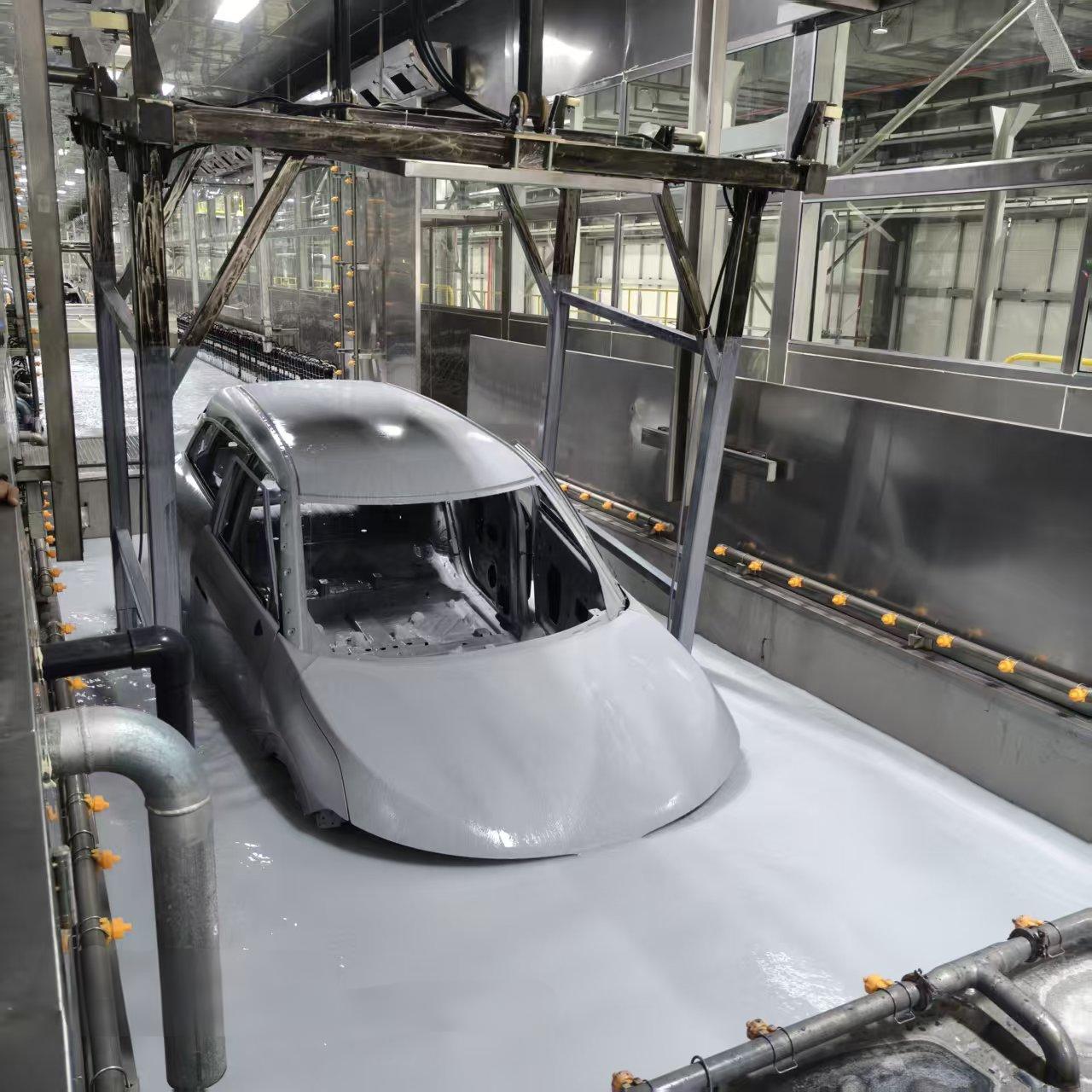
ED line: A full-immersion process ensures coverage of both internal and external surfaces, including body cavities. Simulation-based optimization of tank geometry and circulation layouts, combined with precise control of voltage and circulation parameters, helps achieve uniform film thickness across the underbody and other critical areas, significantly enhancing corrosion protection.
UBS/UBC: Seam-sealing compounds and PVC coatings protect joints and underbody areas. Modular installation reduces on-site construction work, while simulation-optimized spray paths improve coverage in critical areas, enhancing sealing performance, chip resistance, and water resistance.
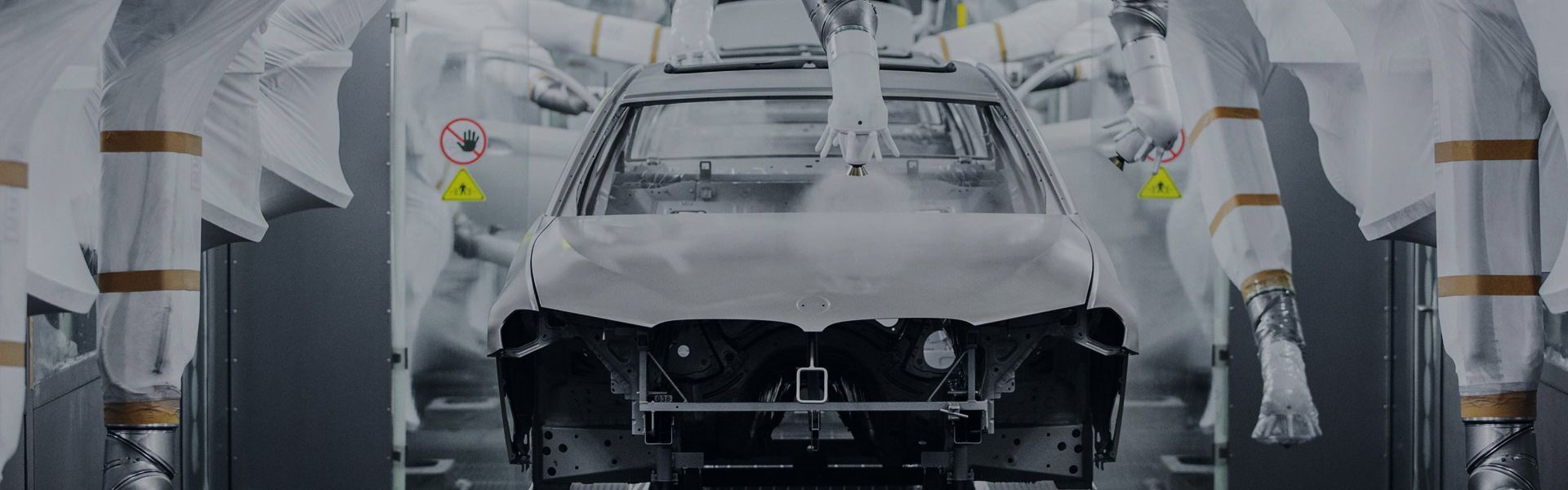
Primer Application: Robotic spraying combined with manual finishing ensures coating quality. Remote technical support enables real-time process optimization and rapid troubleshooting. The coating process for transitions between dissimilar materials is also optimized to improve intercoat adhesion.
Topcoat Application: Fully automated spraying is integrated with intelligent operation and precise temperature and humidity control to deliver consistent color and excellent gloss, while significantly improving first-pass yield. Environmentally compliant coatings are used to meet applicable emissions requirements.
Curing Oven: Zoned temperature control and heat recovery are incorporated into the curing ovens. Optimized temperature profiles balance coating performance with energy efficiency. Interfaces are reserved in Phase I to facilitate seamless integration with the Phase II expansion.
Ultimately, the project achieved a production capacity of 20 JPH, while retaining the flexibility to accommodate future expansion.
Post time: Oct-12-2026



